

Essay I
Why a Painting Begins Before the First Mark
The most important part of a commission is not the image. It is the pressure beneath it - the memory, tension, or private symbolism the work must hold.
Share your details below. Ivan will contact you directly to answer questions about the work, its documentation, and insured delivery.


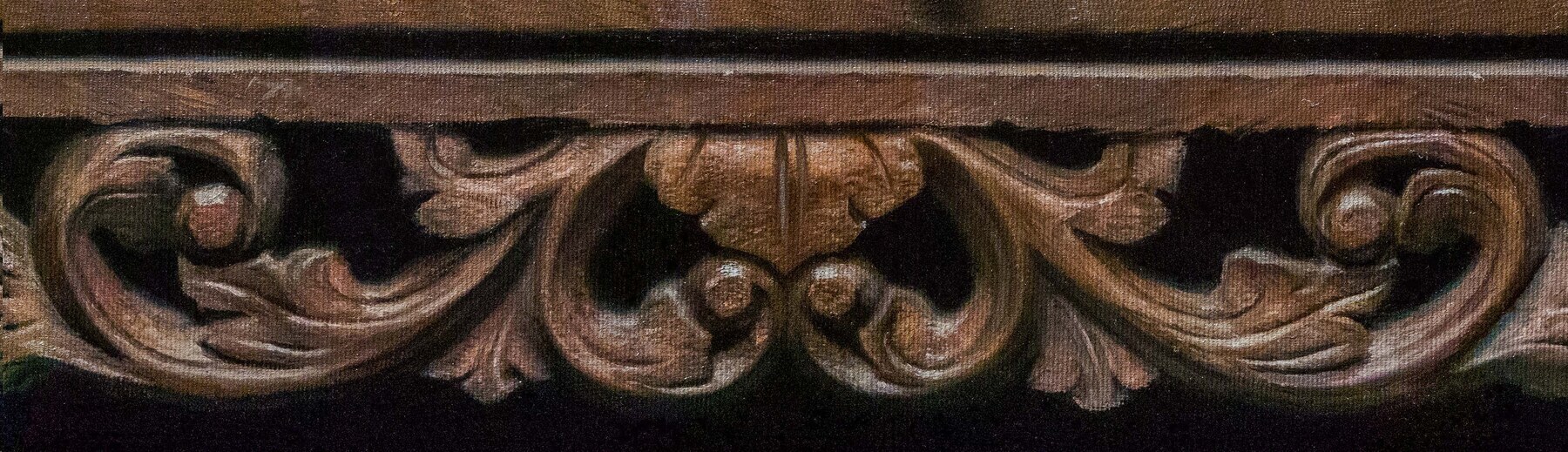

Dissonant Harmonies is the first work in an ongoing series that explores tension as a generative force — between control and surrender, structure and chaos, indulgence and transcendence. The painting was created without a predetermined outcome. There was no sketch, no fixed plan, and no expectation of resolution. Each mark emerged in response to the emotional and psychological state inhabited at the time, forming a dialogue between consciousness and intuition. The work unfolded slowly, over four years and many intermittent sessions.
The title draws from the concept of harmonic dissonance in music — the tension that arises when frequencies clash rather than resolve. In sound, dissonance creates unease, but when used intentionally, it gives depth and makes resolution more powerful. In this work, dissonance becomes a metaphor for lived experience: emotional states layered, unresolved, oscillating.
A background in classical oil painting and realistic tattooing informs the physical language of the piece. Tattooing demands precision, restraint, and adherence to an external narrative — someone else's story inscribed permanently onto the body. Painting offered a necessary counterpoint: a space where muscle memory from tattooing could loosen, where emotional frequency dictated movement, and where intuition replaced obligation.
Each section of the canvas functions like a time-stamped entry, as if painted by different versions of the same person across years of transformation. Rather than viewing the work as a singular image, it is a visual record of shifting internal states — a cumulative map of experiences only fully understood in hindsight. The painting does not depict a moment; it embodies a process.
This piece marks the completion of a first major body of work and the beginning of a broader exploration. It is not a finished answer, but a threshold — where accumulated experiences converge, and where the next frequency becomes possible.

A commission can begin with a person, a memory, a place, a symbol, or a feeling. It does not need to arrive fully formed.
A few images, a person, a memory, or a rough direction is enough to begin. The first step is not to know the final painting - it is to find out whether the idea has enough weight to become one.

Ivan Ivanov is a painter and realism tattoo artist with classical oil painting training from the Angel Academy of Art in Florence.
His commission work sits between academic painting, portraiture, and years of translating personal stories into permanent visual work.
Every commission starts as raw material - a photograph, a story, a half-formed feeling - and is built from there into an original oil painting with weight and presence.
Private commissions are available worldwide, working from a studio in Bulgaria — with U.S. domestic orders supported through a Chicago-based distribution partner for faster delivery.
Before focusing exclusively on painting, Ivan spent more than six years creating commissioned artwork through the medium of realism tattooing.
Working at Chicago Realism Tattoo Studio, he developed a practice centered around observation, design, communication, and execution. Each project required translating deeply personal ideas into something permanent — balancing technical precision with individual meaning.
Over thousands of hours spent designing, refining, and creating custom work, the process became less about the medium itself and more about understanding people. Every commission began with a conversation, evolved through collaboration, and concluded with a finished piece designed to hold personal significance.
That experience continues to shape the way he approaches painting today.
Whether creating a portrait, symbolic work, or large-scale commission, the foundation remains the same: careful observation, thoughtful collaboration, and a commitment to creating work that feels personal, lasting, and deeply considered.
"The painting felt personal before it was even finished. Watching it develop was its own experience."
A private commission begins with what the painting needs to hold—not with a predefined package.
You can arrive with a photograph, memory, person, symbol or unfinished direction. The composition, scale and level of detail can be developed together.
Every commission is quoted around the actual work involved. A smaller, highly detailed composition may require more development than a larger, intentionally restrained painting.
Subject, composition, degree of detail, reference material, dimensions, timeline and delivery are considered before Ivan prepares a clear project quote.
Ivan reviews each idea personally and explains what is realistically possible before you decide whether to proceed.
The most important part of a commission is not the image. It is the pressure beneath it - the memory, tension, or private symbolism the work must hold.
The work moves between academic structure and emotional distortion - discipline used not to decorate, but to contain chaos.
An original painting should not feel like content. It should feel like an artifact that changes the atmosphere of the room around it.
Every commission starts as a conversation, not a finished idea.